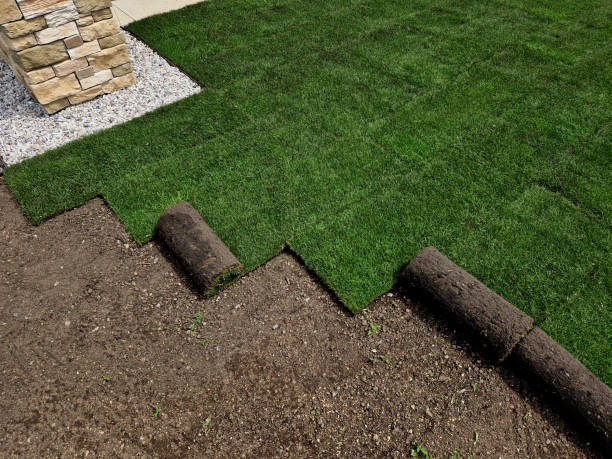
Before ordering sod for your lawn project, one of the most practical questions to answer is simple: how much sod do you actually need? Accurately measuring your yard ensures you order the right amount, avoiding costly shortages mid-installation or excessive waste from over-ordering. This guide walks through how to measure your space properly.
Sod is typically sold by the square foot or in pallet quantities, and ordering the right amount from the start helps keep your project on schedule and on budget. Running short mid-installation can create timing delays (since additional sod may need to be sourced and delivered), while significantly over-ordering wastes money on excess material.
Rather than trying to measure an entire irregularly shaped yard at once, break the space into simpler geometric sections — rectangles, squares, triangles, or circles — that are each easier to measure individually before adding the totals together.
For straightforward rectangular or square sections, measuring is simple: multiply the length by the width to get the square footage for that section.
Example: A section measuring 20 feet by 15 feet equals 300 square feet.
For triangular sections (common where a yard has an angled edge), multiply the base by the height, then divide by two.
Example: A triangular section with a 10-foot base and 8-foot height equals 40 square feet (10 x 8 = 80, divided by 2 = 40).
For circular areas, measure the radius (distance from the center to the edge), then use the formula: radius squared multiplied by pi (approximately 3.14).
Example: A circular area with a 10-foot radius equals approximately 314 square feet (10 x 10 = 100, multiplied by 3.14).
Once you've calculated the square footage for each individual section of your yard, add these figures together for your total square footage requiring sod.
It's generally wise to add a small buffer, often around 5 to 10 percent, to your total calculated square footage to account for cutting waste, irregular edges, and any minor measurement discrepancies. This buffer helps ensure you don't come up short due to necessary trimming during installation.
Forgetting to Subtract Non-Sod Areas
If your yard includes existing planting beds, patios, walkways, or other features that won't be covered in sod, be sure to subtract these areas from your total calculation rather than including them in your sod order.
Not Accounting for Irregular Shapes
Trying to estimate an irregularly shaped yard as a single simple rectangle often leads to inaccurate totals. Breaking the space into smaller, more manageable geometric sections produces more reliable measurements.
Skipping the Waste Buffer
Ordering the exact calculated square footage without any buffer can leave you short once cutting and trimming during installation is factored in.
Measuring Only Once
Double-checking measurements, particularly for larger or more complex areas, helps catch any errors before finalizing your sod order.
Sod is commonly sold by the square foot or by the pallet, with each pallet typically covering a set square footage depending on the specific sod farm and grass variety. Understanding how your supplier sells sod helps you translate your total square footage calculation into an accurate order quantity.
Accurately measuring your yard for a sod installation project ensures you order the right amount from the start, keeping your project on schedule and avoiding unnecessary costs from over- or under-ordering.

Not sure how much sod your project needs? Contact Breaking Ground Outdoor Services for an accurate on-site measurement and estimate.