Getting the size right is one of the most important decisions in planning a pergola, directly affecting both its function and how well it fits proportionally within your overall backyard. This pergola size guide covers key considerations to help you determine the right dimensions for your specific space.
A pergola that's too small won't adequately cover your intended seating or dining area, undermining its purpose as a shade structure. One that's too large relative to your patio and yard can feel overwhelming and disproportionate. Getting the size right ensures your pergola functions well and looks intentional within your overall outdoor living space.
Dining Area
If your pergola will primarily cover an outdoor dining table, measure the table and chairs (accounting for chairs pulled out) and add a reasonable buffer — typically at least a few feet on each side — to ensure adequate coverage and room to move around comfortably.
Lounge or Seating Area
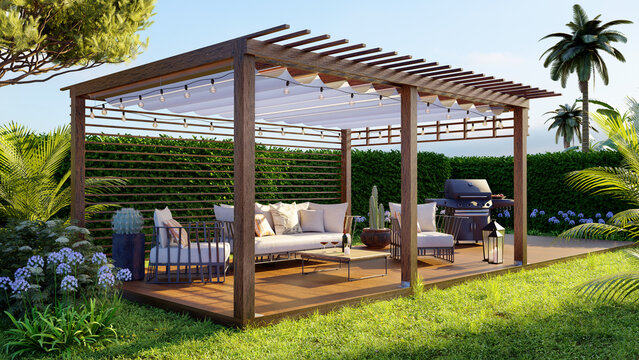
For a seating or lounge area, account for the full furniture arrangement, including any side tables or ottomans, plus enough surrounding space for people to walk around comfortably.
Outdoor Kitchen
If the pergola will cover an outdoor kitchen, ensure the structure provides adequate coverage over the entire cooking and counter space, with some buffer for splashing rain or wind-blown sun exposure at the edges.
Multi-Purpose Space
For a pergola covering multiple zones (dining plus lounging, for example), total the space needed for each individual zone, plus any transition space between them.
Small Pergolas
Smaller pergolas, often in the range of 10x10 to 12x12 feet, work well for a modest seating area or a small dining setup, suitable for more compact patios or as a secondary feature in a larger yard.
Medium Pergolas
A mid-sized pergola, often ranging from 12x16 to 16x20 feet, accommodates larger dining sets or combined dining and lounging areas, suitable for moderately sized patios.
Large Pergolas
Larger pergolas, exceeding 16x20 feet or more, are typically used for expansive outdoor living spaces incorporating multiple zones, such as dining, lounging, and perhaps an outdoor kitchen all under one structure.
Beyond just the furniture it needs to cover, your pergola's size should feel proportionate to your overall patio space and yard. A pergola that consumes nearly the entire patio can feel overwhelming, while one that occupies only a small corner of an otherwise large space might look disconnected or insufficient relative to the property's scale.
Pergola height isn't just about the footprint — vertical proportions matter too. Most residential pergolas range from about 8 to 12 feet in height, with taller structures generally suiting larger footprints and taller homes, while more modest heights work well for smaller pergolas and single-story homes.
Attached pergolas are often sized based on the adjacent wall length and the specific area of the home they're extending from, sometimes constraining size options based on the home's architecture.
Freestanding pergolas offer more flexibility in sizing, since they aren't tied to an existing structure's dimensions, allowing size decisions to be driven purely by the intended use and available yard space.
Underestimating Furniture Footprint
Failing to account for chairs pulled out from a table, or space needed to walk around furniture comfortably, can result in a pergola that feels cramped despite seemingly adequate initial measurements.
Ignoring Sun Angle Throughout the Day
A pergola sized only for direct overhead coverage may not adequately shade furniture during morning or evening hours when the sun is at a lower angle, worth considering especially for open slat designs.
Overbuilding Relative to the Property
An oversized pergola relative to the home and yard can feel disproportionate and may not deliver a good return on the investment relative to actual functional need.
A properly sized pergola enhances both the function and visual appeal of your outdoor living space, providing adequate coverage for its intended use while feeling proportionate to your overall property. Taking the time to measure and plan carefully pays off in a structure that feels genuinely well-suited to your space.

Need help determining the right pergola size for your yard? Contact Breaking Ground Outdoor Services for expert design guidance.